When Is DOT Post-Accident Drug Testing Required?
Most employers do not fail post-accident testing because they refused to test. They fail because they tested when they did not have to, or did not test when they did.
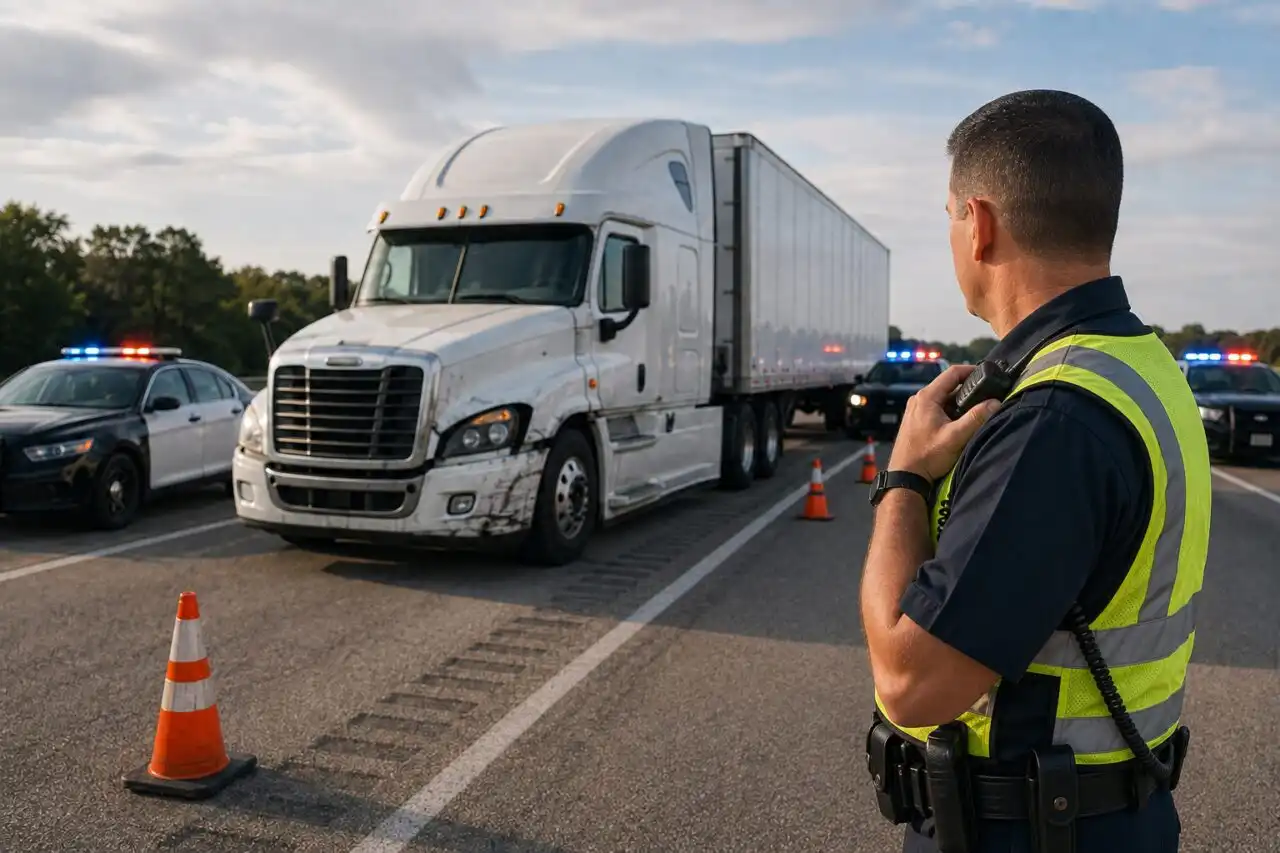
A driver has an accident. Police are on scene. A supervisor calls and asks the only question that matters in that moment: do we need to send them for a test?
Guessing is expensive in both directions. Miss a required test and you have an FMCSA violation with no way to go back and fix it. Send a driver for a DOT test the regulation never required and you have created a federal testing record with consequences you did not intend.
The answer is in one regulation. It is worth knowing before the phone rings.
The Three Triggering Conditions
Under 49 CFR § 382.303, post-accident testing applies following an occurrence involving a commercial motor vehicle operating on a public road in commerce. Within that scope, three conditions can trigger testing:
- Loss of human life. The employer must test any surviving driver who was performing safety-sensitive functions with respect to the vehicle.
- Bodily injury with immediate medical treatment away from the scene — but only if the driver also receives a citation.
- Disabling damage requiring a vehicle to be towed from the scene — again, only if the driver also receives a citation.
The regulation sets this out in a table.
| Type of accident | Citation issued to the CMV driver | Test required |
|---|---|---|
| Human fatality | Yes | Yes |
| No | Yes | |
| Bodily injury with immediate medical treatment away from the scene | Yes | Yes |
| No | No | |
| Disabling damage to any motor vehicle requiring tow away | Yes | Yes |
| No | No |
The Citation Type Is Also Crucial
Read the table again, and one pattern stands out.
In a fatality, testing is required whether or not your driver is cited. Fault is not the question. A driver stopped at a red light when another vehicle runs into them, causing a death, is still subject to post-accident testing.
In the other two categories, the citation type is also crucial. Serious injury alone does not require a DOT test. A tow-away alone does not require a DOT test. A moving traffic violation resulting from the accident dictates the subsequent process.
This is where employers most often get it wrong, and they get it wrong in both directions — sending drivers for DOT tests after every tow-away regardless of whether a moving violation citation was issued, or assuming a bad-looking accident with no such citation must require one.
Note also that the citation windows differ by test type. For alcohol testing, the citation must be received within 8 hours of the occurrence. For controlled substances testing, within 32 hours.
Two Terms That Decide Close Cases
“Immediately receives medical treatment away from the scene”
Every word in that phrase is doing work.
Treatment must occur away from the scene — care administered at the roadside does not satisfy it. And it must be immediate. Someone who declines transport, goes home, and visits urgent care later that afternoon has not immediately received medical treatment away from the scene.
“Disabling damage requiring the vehicle to be transported away by a tow truck or other motor vehicle”
The test is whether a vehicle had to be towed, not whether it looks badly damaged. A vehicle driven away under its own power has not incurred disabling damage under this provision, however extensive the cosmetic damage appears.
Note that the provision refers to one or more motor vehicles — not only your vehicle. If the other vehicle involved required a tow, that condition may be met.
“The Police Already Tested Him”
This comes up after almost every serious accident, and the regulation addresses it directly.
Under § 382.303(g), the results of a breath or blood alcohol test, or a urine test for controlled substances, conducted by federal, state, or local officials with independent authority for the test, are considered to meet the requirements of this section — provided the tests conform to the applicable federal, state, or local testing requirements, and the employer obtains the results.
That final condition is where employers come unstuck. A test performed by law enforcement only satisfies your obligation if you actually get the results. “The police handled it” is not a compliant position if the file is empty when FMCSA asks.
The Driver Has Obligations Too
Under § 382.303(e), a driver subject to post-accident testing must remain readily available for testing, or the employer may deem them to have refused to submit to testing.
The same provision draws a clear boundary. Nothing in the section requires delaying necessary medical attention for injured people, or prohibits a driver from leaving the scene for the period needed to obtain assistance in responding to the accident or to obtain necessary emergency medical care.
Separately, under 49 CFR § 382.209, a driver required to take a post-accident alcohol test must not use alcohol for eight hours following the accident, or until the test is performed, whichever comes first. Drivers rarely know this. It belongs in the instructions your supervisor gives at the scene.
Once Testing Is Required, the Clock Is Short
Determining that a test is required is only the first decision. The deadlines run from the accident, not from the moment someone works out that testing applies.
- Alcohol — 2 hours
- If the test has not been administered, prepare and maintain a record stating why it was not promptly administered.
- Alcohol — 8 hours
- Cease attempts to administer the test and maintain the same record.
- Controlled substances — 32 hours
- Cease attempts to administer the test and maintain a record stating why it was not promptly administered.
Source: 49 CFR § 382.303(d)(1)–(2). Records must be submitted to FMCSA upon request.
Those windows are the reason the determination has to be fast. An employer who spends three hours deciding whether a test is required has already missed the two-hour alcohol documentation point, and is working against the eight-hour ceiling.
More on managing that window in our article on 24/7 emergency post-accident collections.
These Rules Are FMCSA’s
Everything above applies to drivers subject to FMCSA regulations. It does not describe every DOT-regulated employer, and it does not describe non-DOT employers at all.
Other DOT modal agencies — FAA, FRA, PHMSA, USCG, and FTA — set their own post-accident triggers and timing. An employer operating across more than one mode is working against more than one rule set.
Non-DOT employers are governed by state law and by their own written policy. Some states impose thresholds of their own; others leave the question to the employer. That is a separate analysis, covered in our article on post-accident testing and state laws.
Which is why instructing supervisors to “send them for a drug test after any accident” is not a compliance procedure. It is a habit that will eventually produce either a missed federal test or an unnecessary one.
Could Your Supervisor Answer These Tonight?
A qualifying accident happens at 11:00 p.m. Before anyone can act, someone has to answer:
- Was the driver operating a commercial motor vehicle on a public road in commerce?
- Was there a fatality?
- If not, was anyone taken from the scene for immediate medical treatment, or was a vehicle towed?
- Has the driver been cited for a moving violation arising from the accident — or might they be within the next 8 or 32 hours?
- Is this a DOT test or a company test, and under whose authority are we testing?
- Who decides, and who do they call?
If different people in your organization would answer those differently, the gap exists now. It just has not been tested yet.
Supervisor training is where this gets fixed. A supervisor who can work through the trigger conditions at the roadside is worth considerably more than a policy document nobody reads at 11:00 p.m. Supervisor training should cover post-accident determination alongside reasonable suspicion.
Accident Happening Right Now?
NMS Screening & Compliance provides 24/7 emergency drug and alcohol testing collections nationwide. Call (800) 269-0502 for immediate assistance.
Not Sure Your Post-Accident Procedure Would Hold Up?
Start with the NMS 60-Second Risk Assessment.
Want Us to Review Your Current Policy?
Contact Maria Delisle, VP of Business Development / Sales & Training, for a free policy review.
[email protected]
Direct: (561) 560-8131
Toll-Free: (800) 269-0502 ext. 101
This material is provided for educational and informational purposes only and is not legal advice.